Slide 1 — Cover
Employment of Teachers with Disabilities in the Republic of Korea. A Rights-Holder Monitoring Report through the Lens of CRPD Article 27 (Work and Employment)
Presented by Kim Hunyong (President, Korea Hamkke Union of Disabled Teachers) · Kim Sora
Commissioned by DPI KOREA · Supported by the Ministry of Health and Welfare
Forum on the 20th Anniversary of the CRPD: Individual Communications & Treaty Implementation · 18 May 2026
Slide 2
About the Report — A Monitoring Report Written by the Rights-Holders Themselves
- Monitors the employment of teachers with disabilities through CRPD Art. 27 and evaluates implementation of the 2022 Concluding Observations (CRPD/C/KOR/CO/2-3) from the rights-holders' perspective
- An intersection of Art. 27 (work) and Art. 24 (education) — disabled teachers are both educators and workers
- A blind spot of the public sector, largely absent from the State report
- “Nothing about us without us” — authored by a rights-holder and union leader
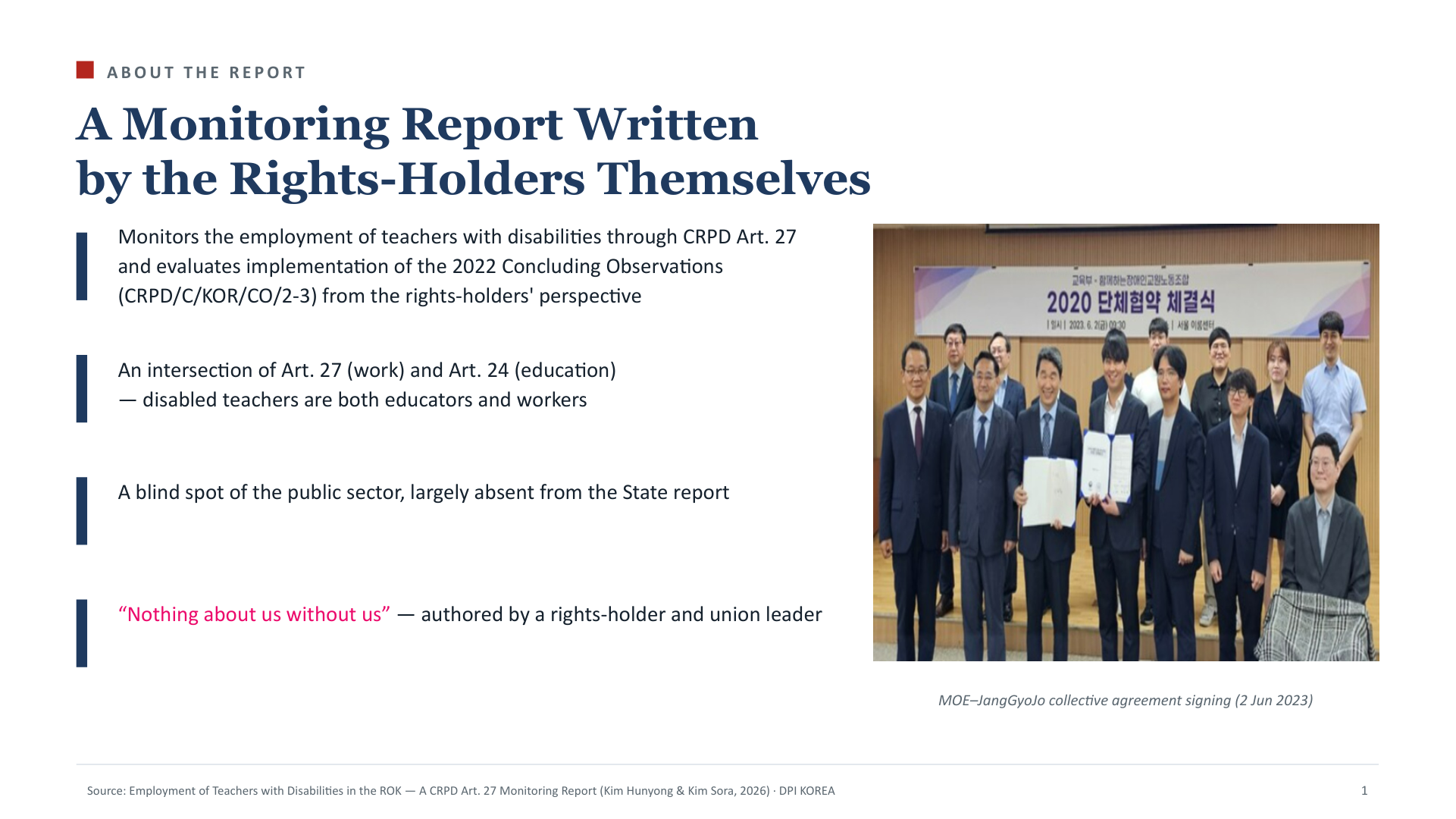
MOE–JangGyoJo collective agreement signing (2 Jun 2023)
Slide 3
Normative Basis — CRPD Article 27 and the 2022 Concluding Observations
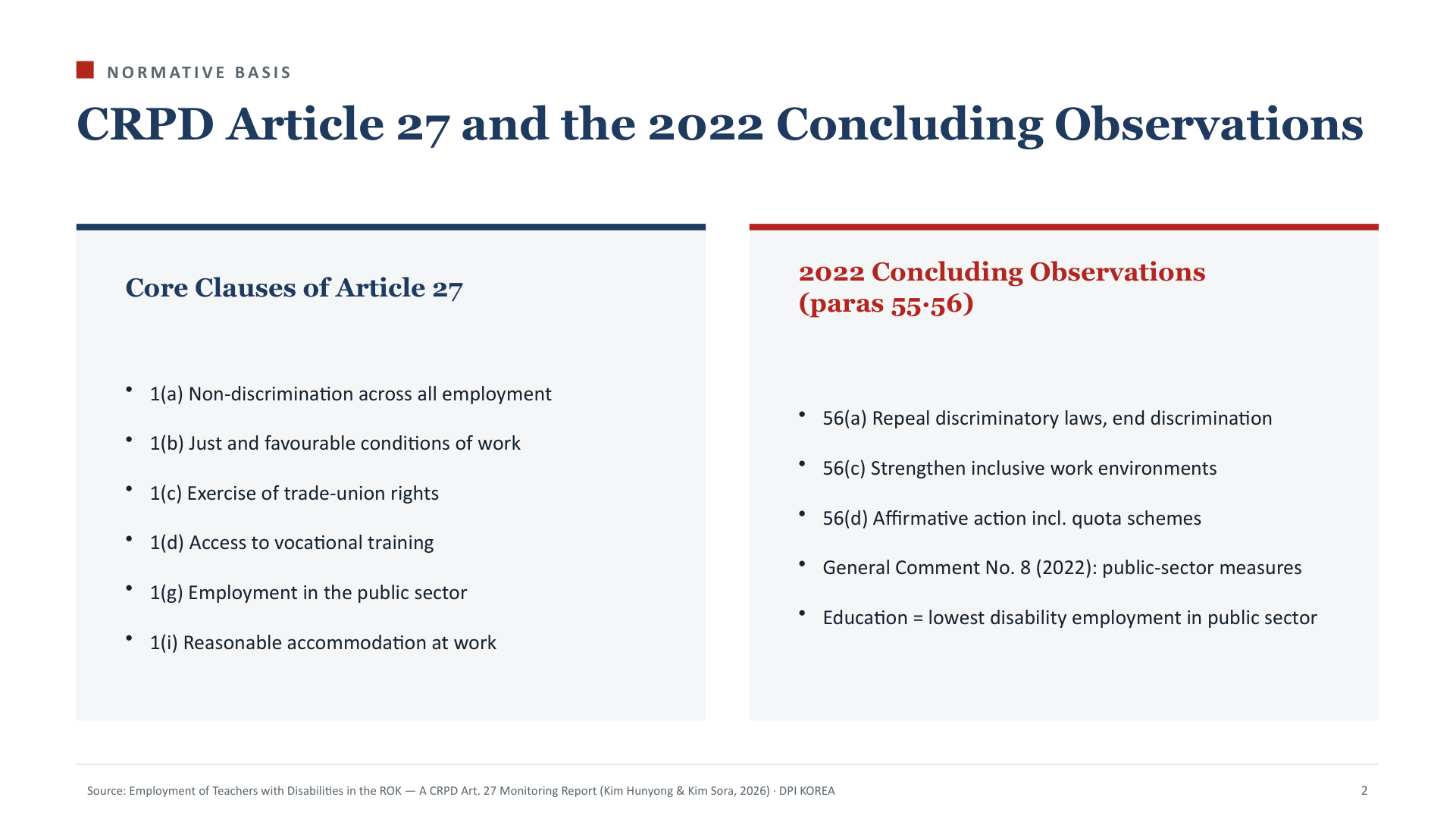
Core Clauses of Article 27
- 1(a) Non-discrimination across all employment
- 1(b) Just and favourable conditions of work
- 1(c) Exercise of trade-union rights
- 1(d) Access to vocational training
- 1(g) Employment in the public sector
- 1(i) Reasonable accommodation at work
2022 Concluding Observations (paras 55·56)
- 56(a) Repeal discriminatory laws, end discrimination
- 56(c) Strengthen inclusive work environments
- 56(d) Affirmative action incl. quota schemes
- General Comment No. 8 (2022): public-sector measures
- Education = lowest disability employment in public sector
Slide 4
Status ① Employment Rate — Less Than Half the Statutory Employment Quota
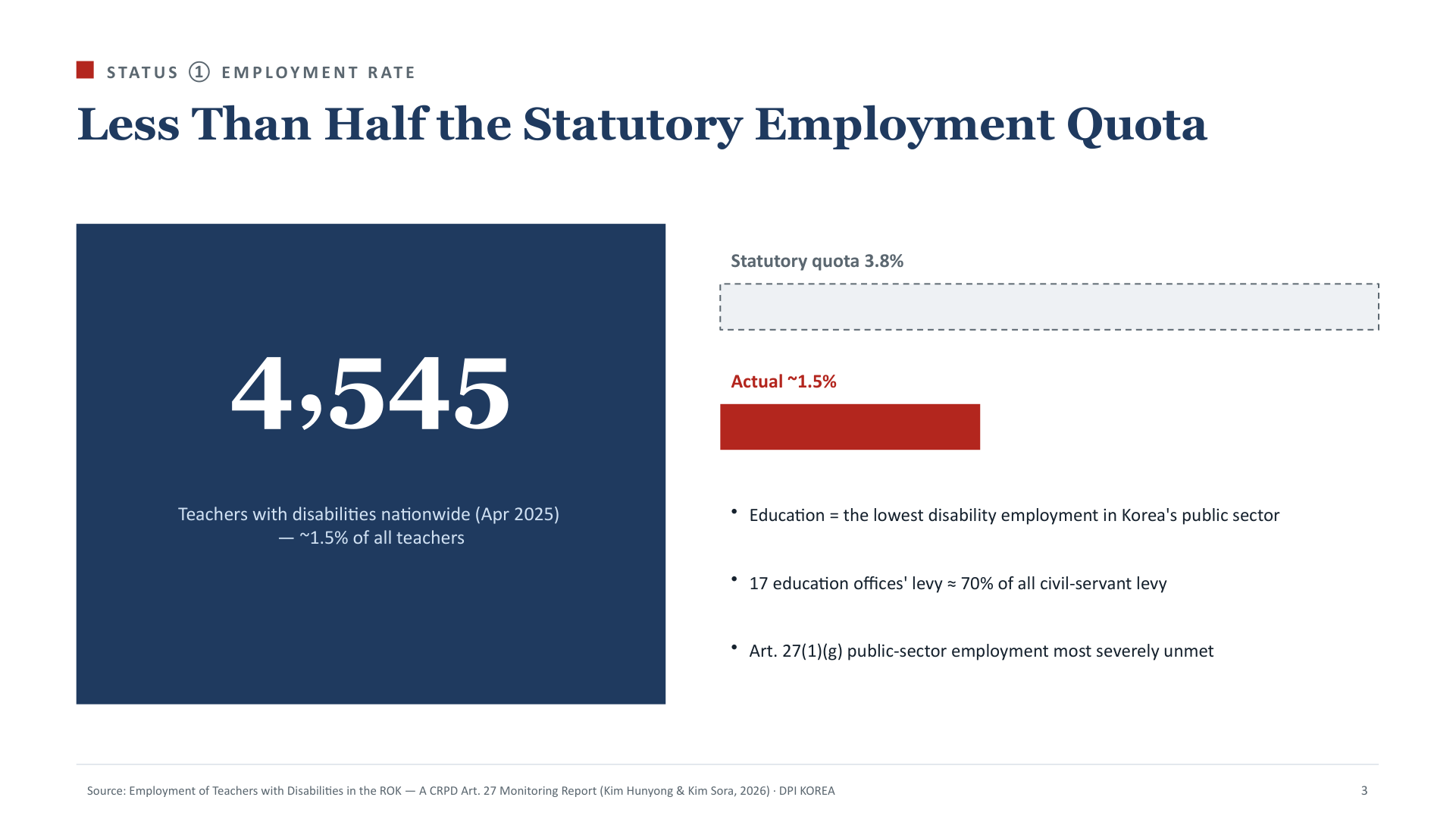
4,545 — Teachers with disabilities nationwide (Apr 2025) — ~1.5% of all teachers
Actual ~1.5% vs Statutory quota 3.8%
- Education = the lowest disability employment in Korea's public sector
- 17 education offices' levy ≈ 70% of all civil-servant levy
- Art. 27(1)(g) public-sector employment most severely unmet
Slide 5
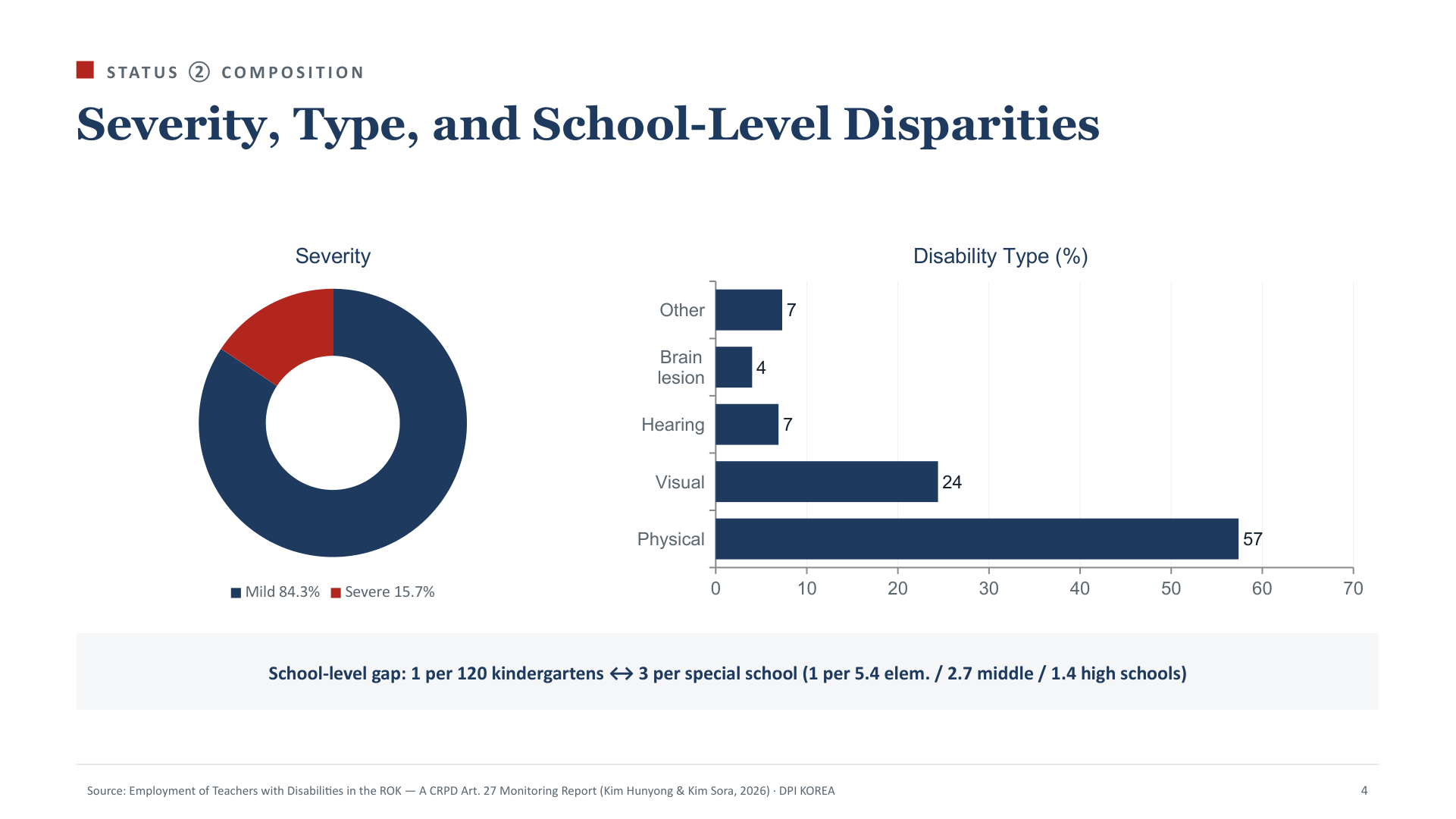
Status ② Composition — Severity, Type, and School-Level Disparities
Severity: Mild 84.3%, Severe 15.7%
Disability Type (%): Physical 57.4%, Visual 24.4%, Hearing 6.9%, Brain lesion 4%, Other 7.3%
School-level gap: 1 per 120 kindergartens ↔ 3 per special school (1 per 5.4 elem. / 2.7 middle / 1.4 high schools)
Slide 6
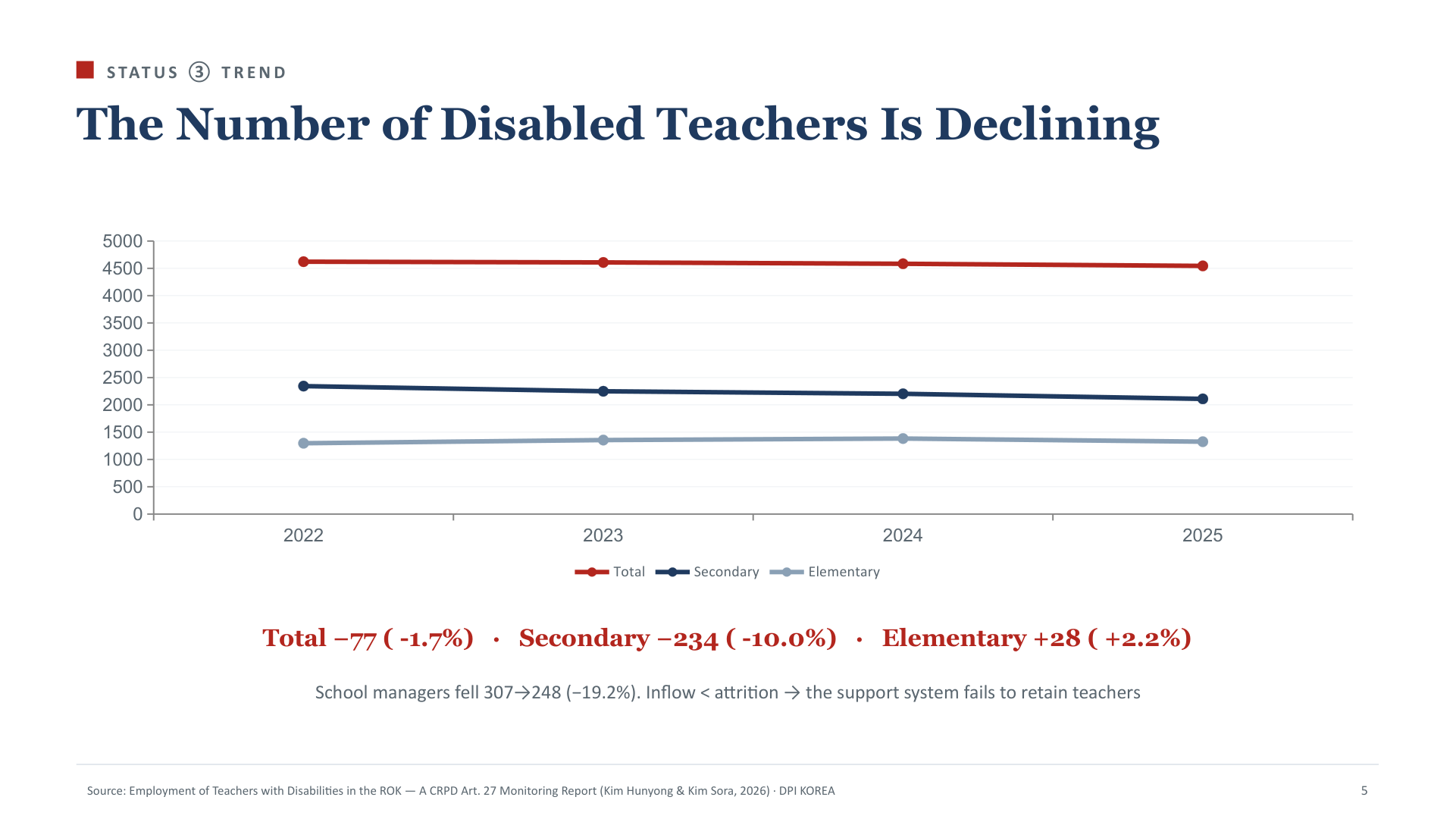
Status ③ Trend — The Number of Disabled Teachers Is Declining
Total (2022, 2023, 2024, 2025): 4622, 4608, 4584, 4545
Secondary (2022, 2023, 2024, 2025): 2344, 2249, 2203, 2110
Elementary (2022, 2023, 2024, 2025): 1297, 1355, 1383, 1325
Total −77 (−1.7%) · Secondary −234 (−10.0%) · Elementary +28 (+2.2%)
School managers fell 307→248 (−19.2%). Inflow < attrition → the support system fails to retain teachers
Slide 7
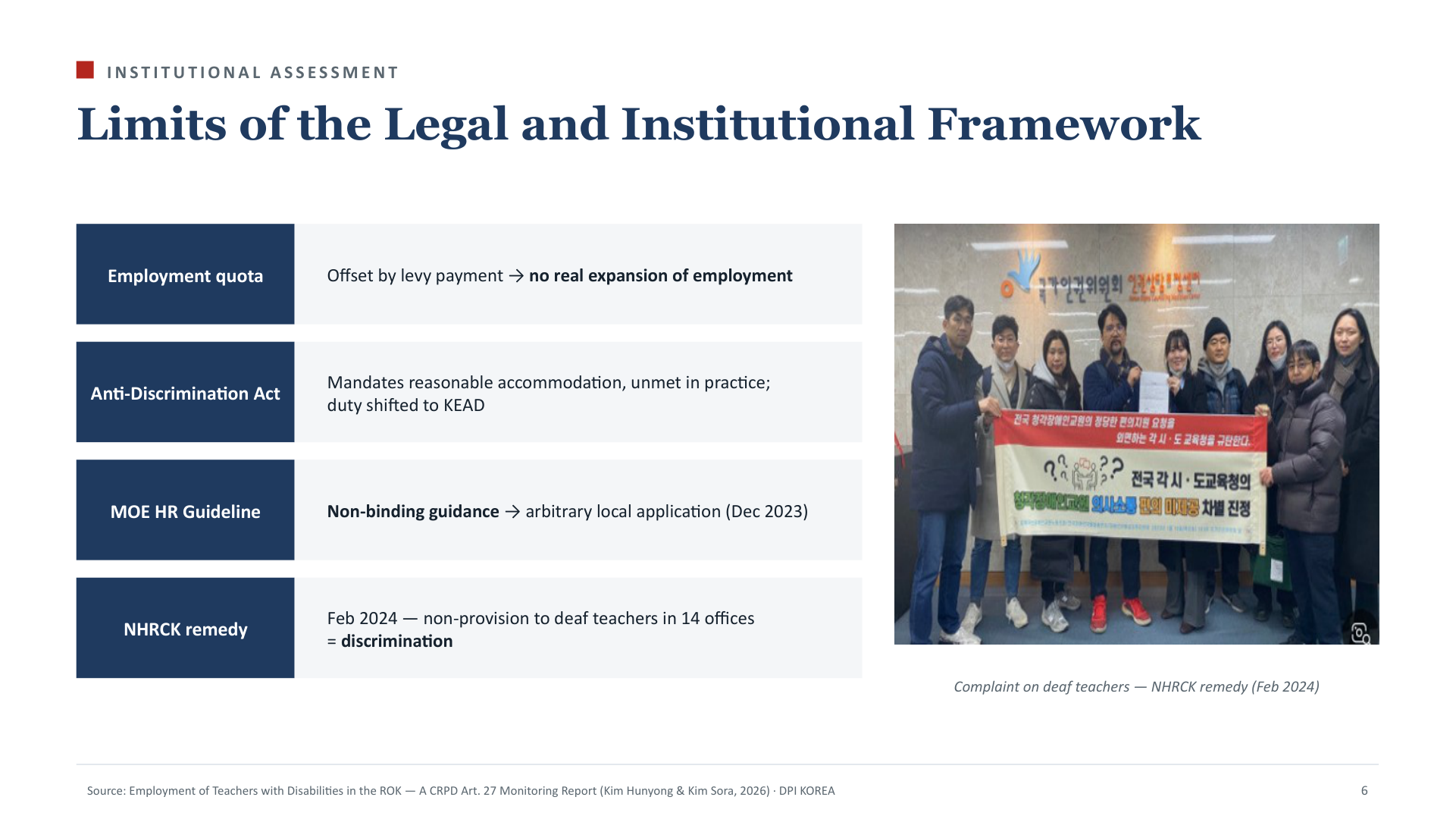
Institutional Assessment — Limits of the Legal and Institutional Framework
- Employment quota: Offset by levy payment → no real expansion of employment
- Anti-Discrimination Act: Mandates reasonable accommodation, unmet in practice; duty shifted to KEAD
- MOE HR Guideline: Non-binding guidance → arbitrary local application (Dec 2023)
- NHRCK remedy: Feb 2024 — non-provision to deaf teachers in 14 offices = discrimination
Complaint on deaf teachers — NHRCK remedy (Feb 2024)
Slide 8
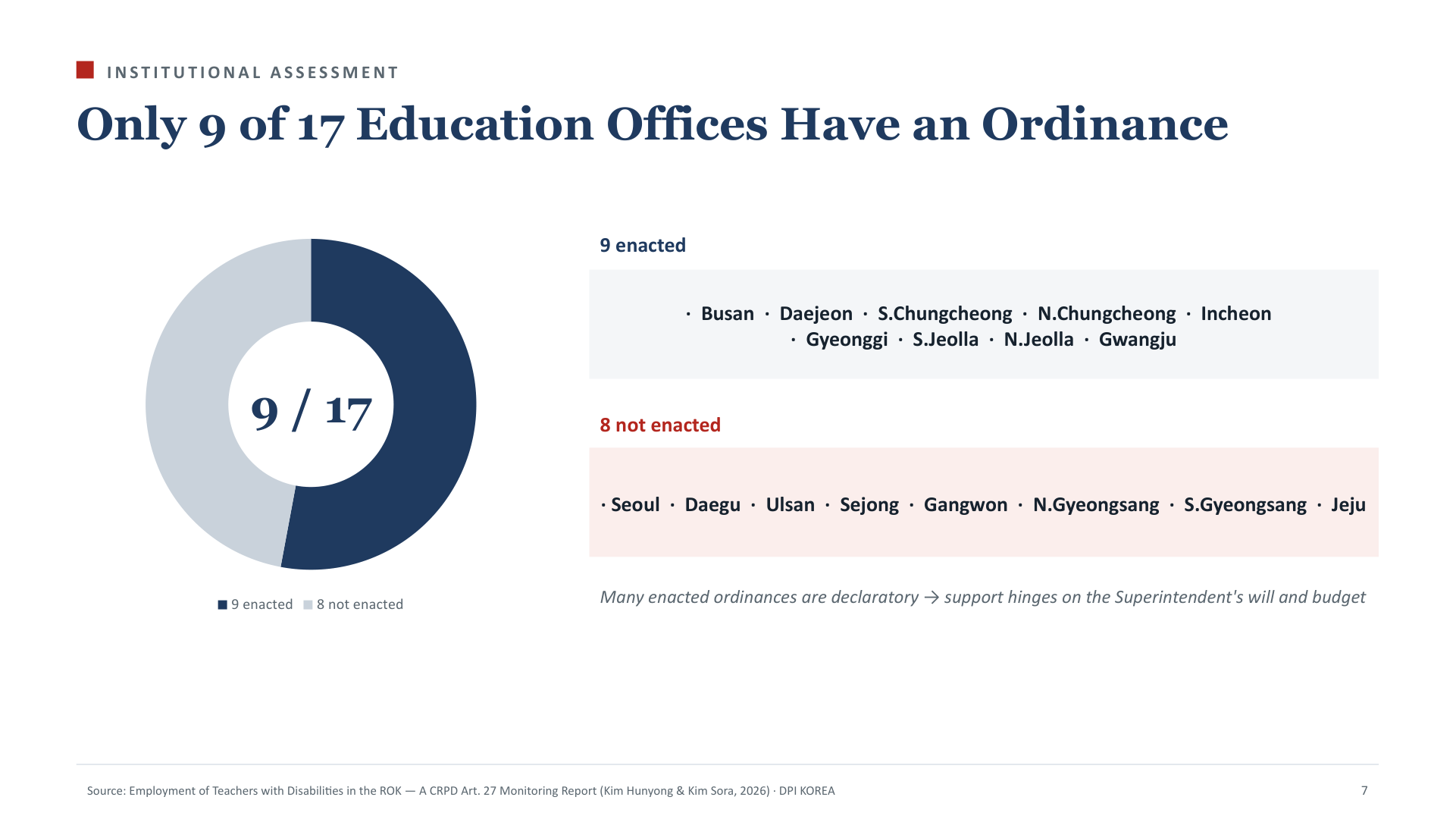
Institutional Assessment — Only 9 of 17 Education Offices Have an Ordinance
Many enacted ordinances are declaratory → support hinges on the Superintendent's will and budget
9 enacted / 8 not enacted
Enacted: Busan, Daejeon, S.Chungcheong, N.Chungcheong, Incheon, Gyeonggi, S.Jeolla, N.Jeolla, Gwangju
Not enacted: Seoul, Daegu, Ulsan, Sejong, Gangwon, N.Gyeongsang, S.Gyeongsang, Jeju
Slide 9
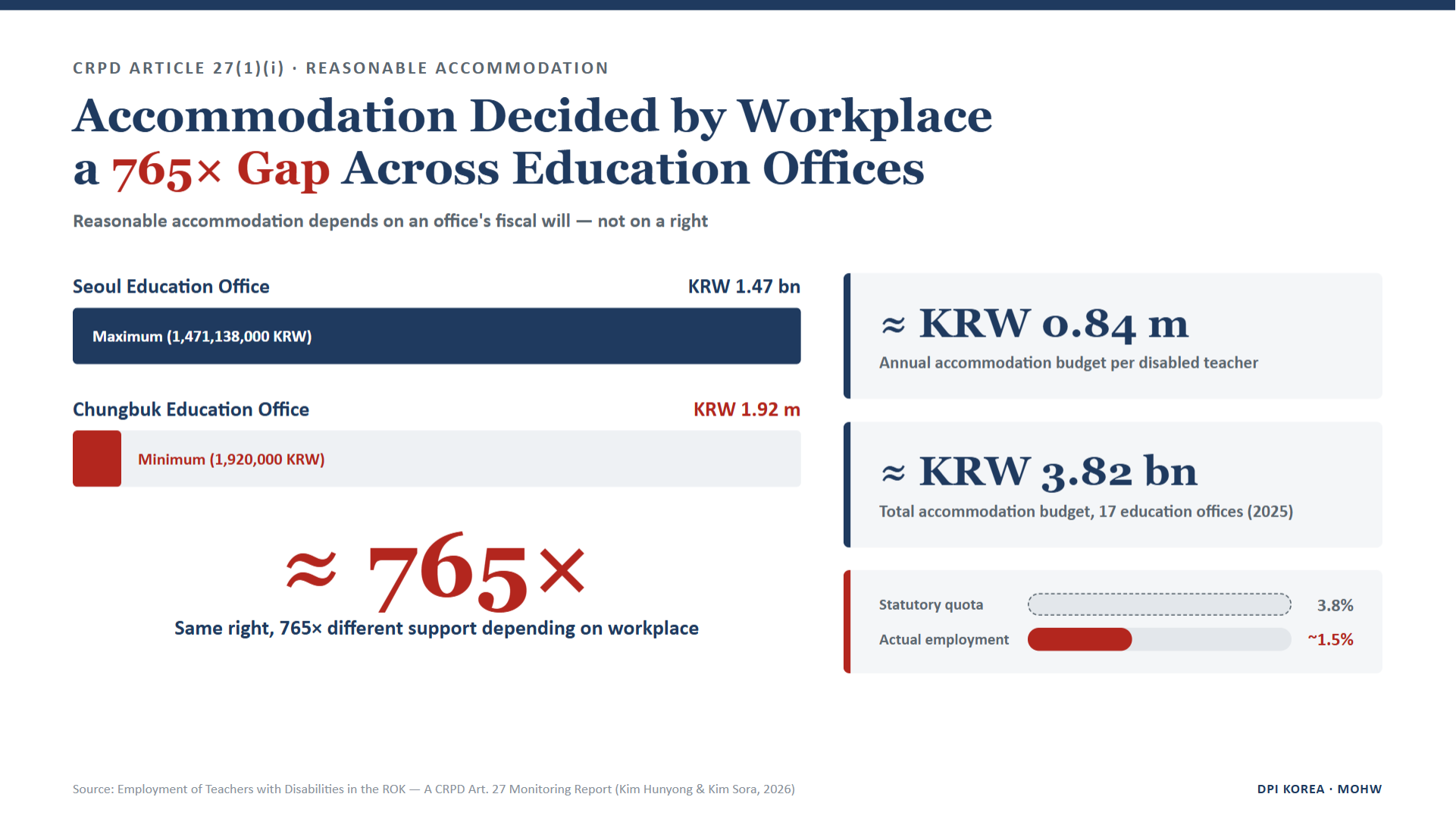
Status ④ Accommodation Budget — Accommodation Decided by Workplace — a 765× Gap
Slide 10
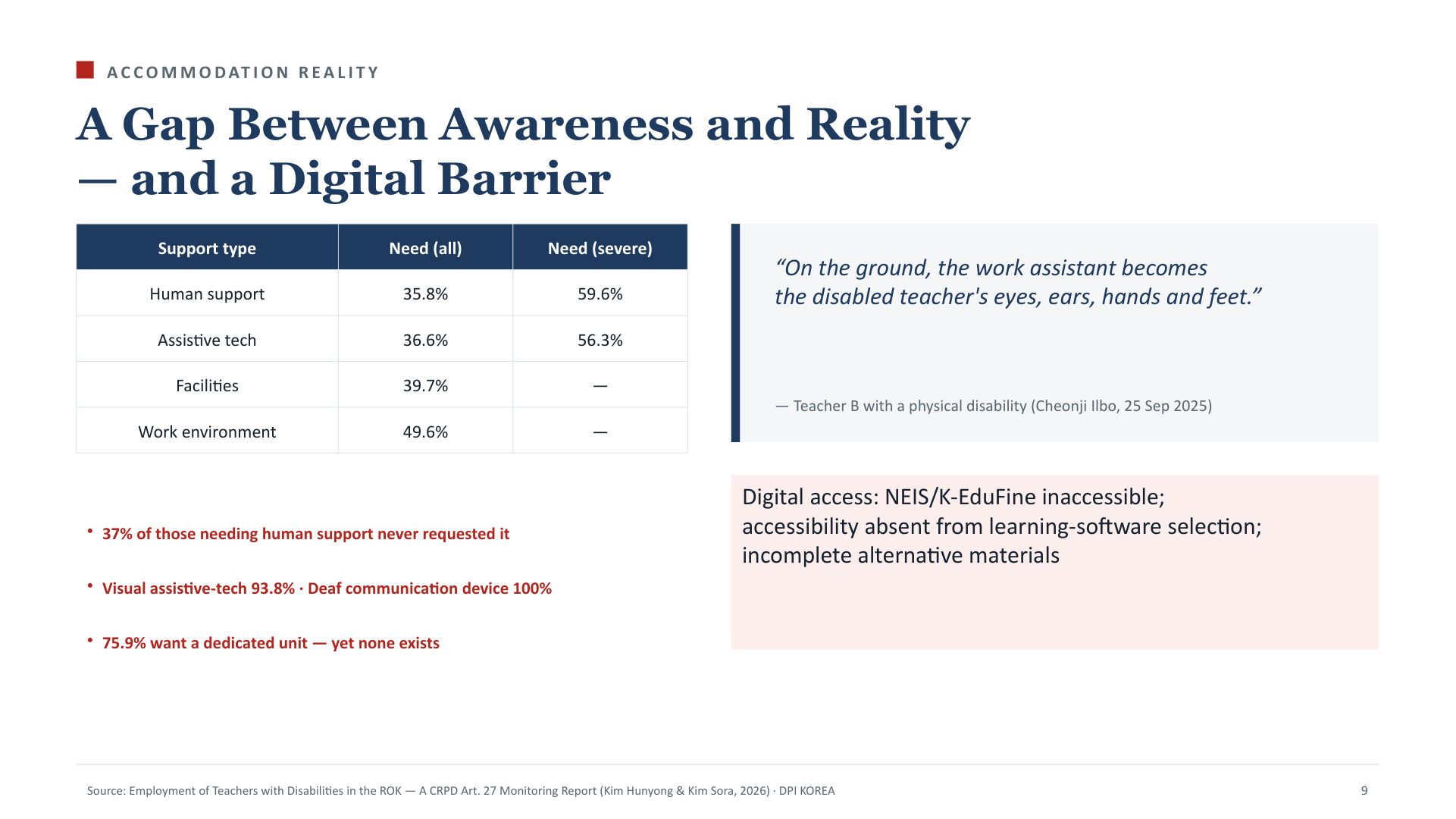
Accommodation Reality — A Gap Between Awareness and Reality — and a Digital Barrier
Digital access: NEIS/K-EduFine inaccessible; accessibility absent from learning-software selection; incomplete alternative materials
- Support type · Need (all) · Need (severe)
- Human support · 35.8% · 59.6%
- Assistive tech · 36.6% · 56.3%
- Facilities · 39.7% · —
- Work environment · 49.6% · —
- 37% of those needing human support never requested it
- Visual assistive-tech 93.8% · Deaf communication device 100%
- 75.9% want a dedicated unit — yet none exists
“On the ground, the work assistant becomes the disabled teacher's eyes, ears, hands and feet.”
— Teacher B with a physical disability (Cheonji Ilbo, 25 Sep 2025)
Slide 11
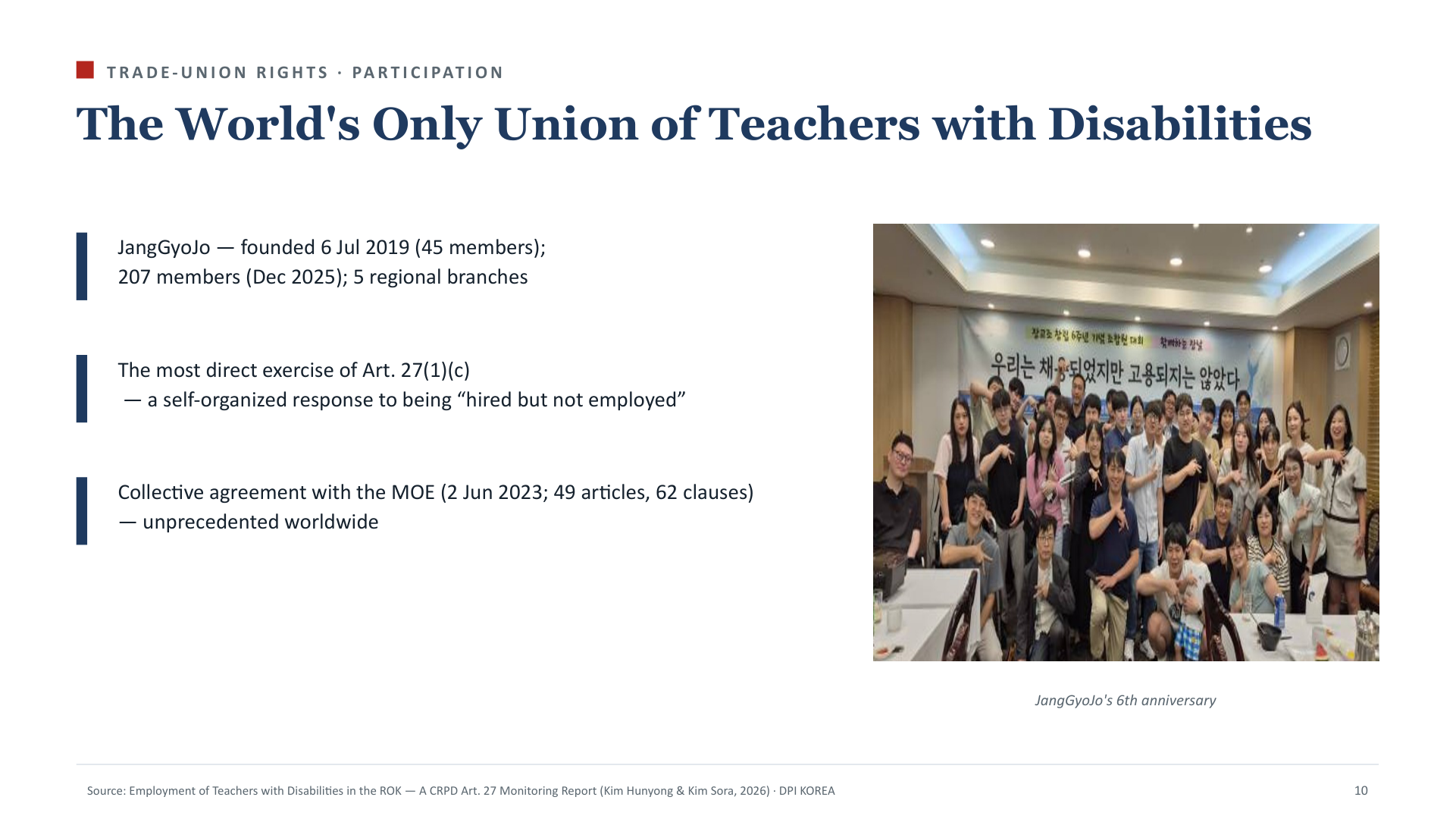
Trade-Union Rights · Participation — The World's Only Union of Teachers with Disabilities
- JangGyoJo — founded 6 Jul 2019 (45 members); 207 members (Dec 2025); 5 regional branches
- The most direct exercise of Art. 27(1)(c) — a self-organized response to being “hired but not employed”
- Collective agreement with the MOE (2 Jun 2023; 49 articles, 62 clauses) — unprecedented worldwide
JangGyoJo's 6th anniversary
Slide 12
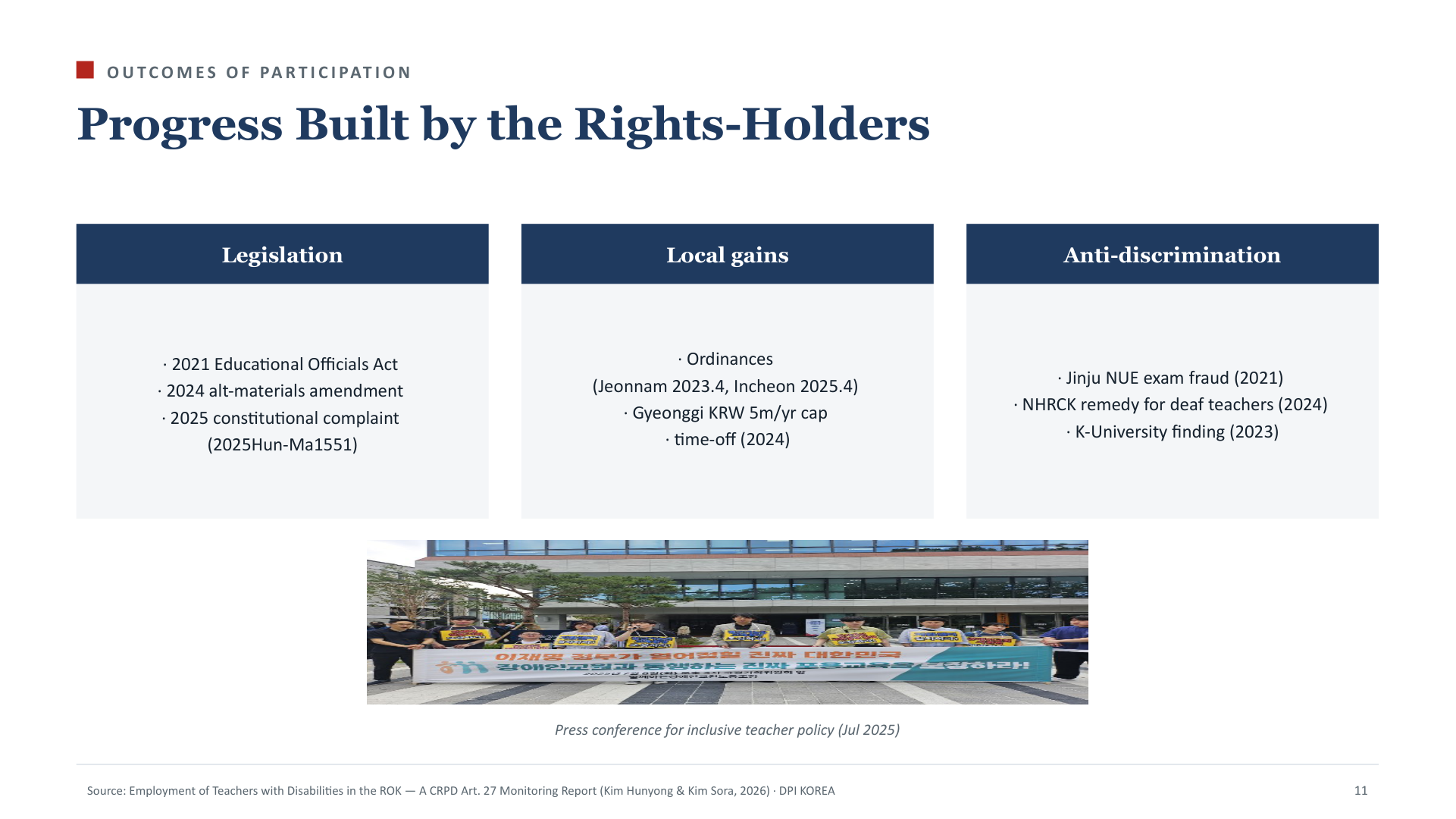
Outcomes of Participation — Progress Built by the Rights-Holders
- Legislation: 2021 Educational Officials Act · 2024 alt-materials amendment · 2025 constitutional complaint (2025Hun-Ma1551)
- Local gains: Ordinances (Jeonnam 2023.4, Incheon 2025.4) · Gyeonggi KRW 5m/yr cap · time-off (2024)
- Anti-discrimination: Jinju NUE exam fraud (2021) · NHRCK remedy for deaf teachers (2024) · K-University finding (2023)
Press conference for inclusive teacher policy (Jul 2025)
Slide 13
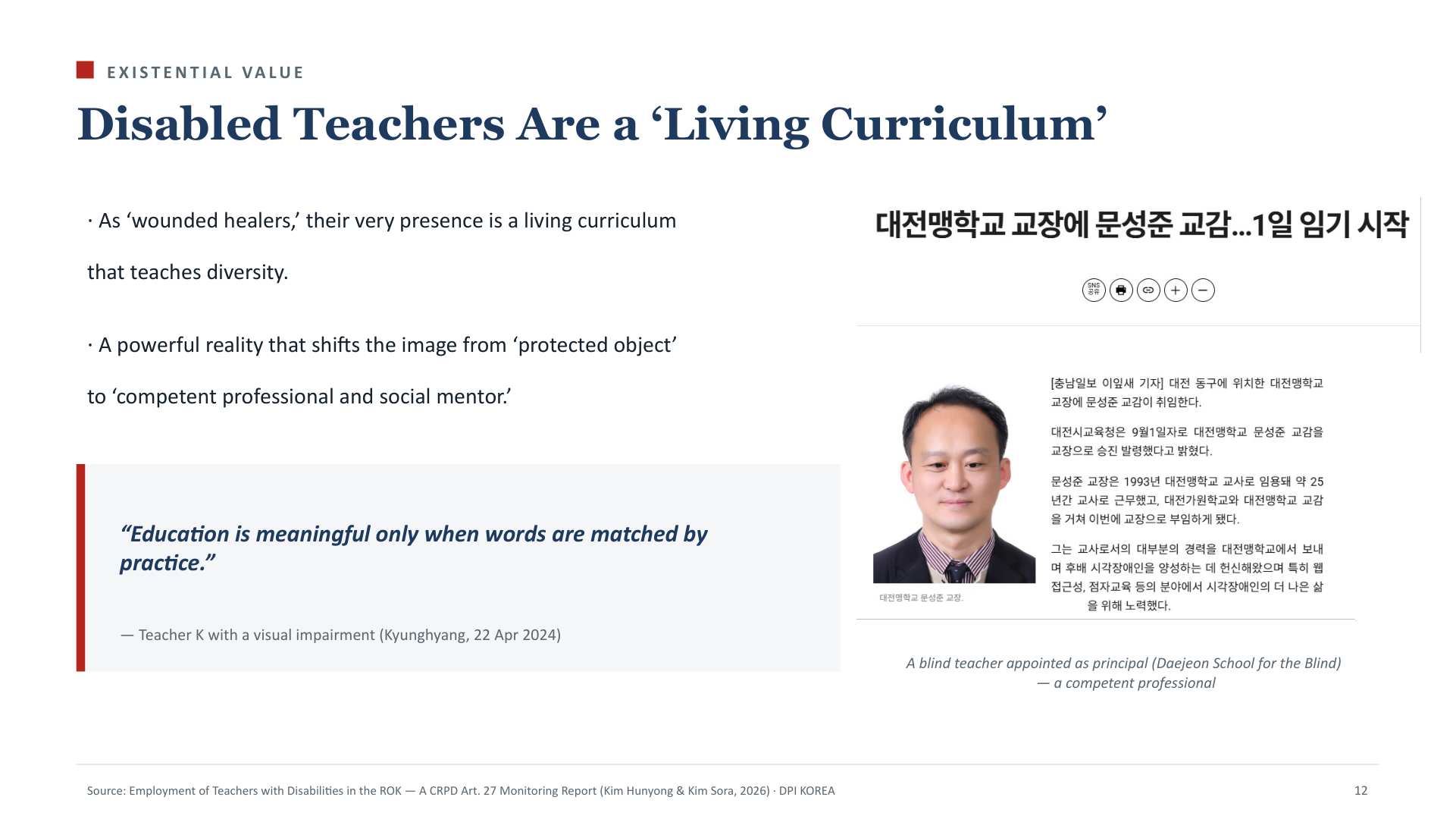
Existential Value — Disabled Teachers Are a ‘Living Curriculum’
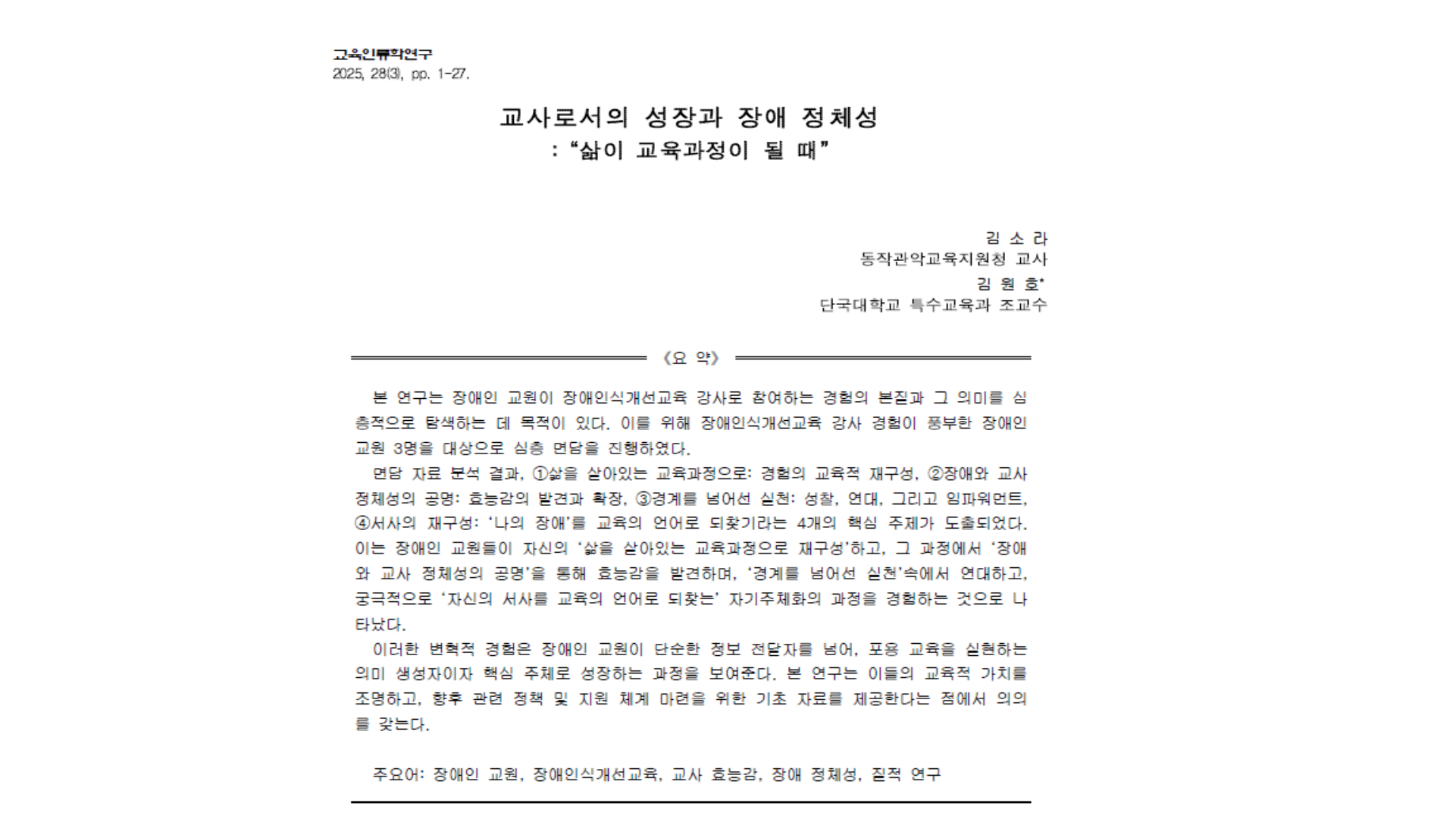
As ‘wounded healers,’ their very presence is a living curriculum that teaches diversity.
A powerful reality that shifts the image from ‘protected object’ to ‘competent professional and social mentor.’
“Education is meaningful only when words are matched by practice.”
— Teacher K with a visual impairment (Kyunghyang, 22 Apr 2024)
A blind teacher appointed as principal (Daejeon School for the Blind) — a competent professional
Slide 14
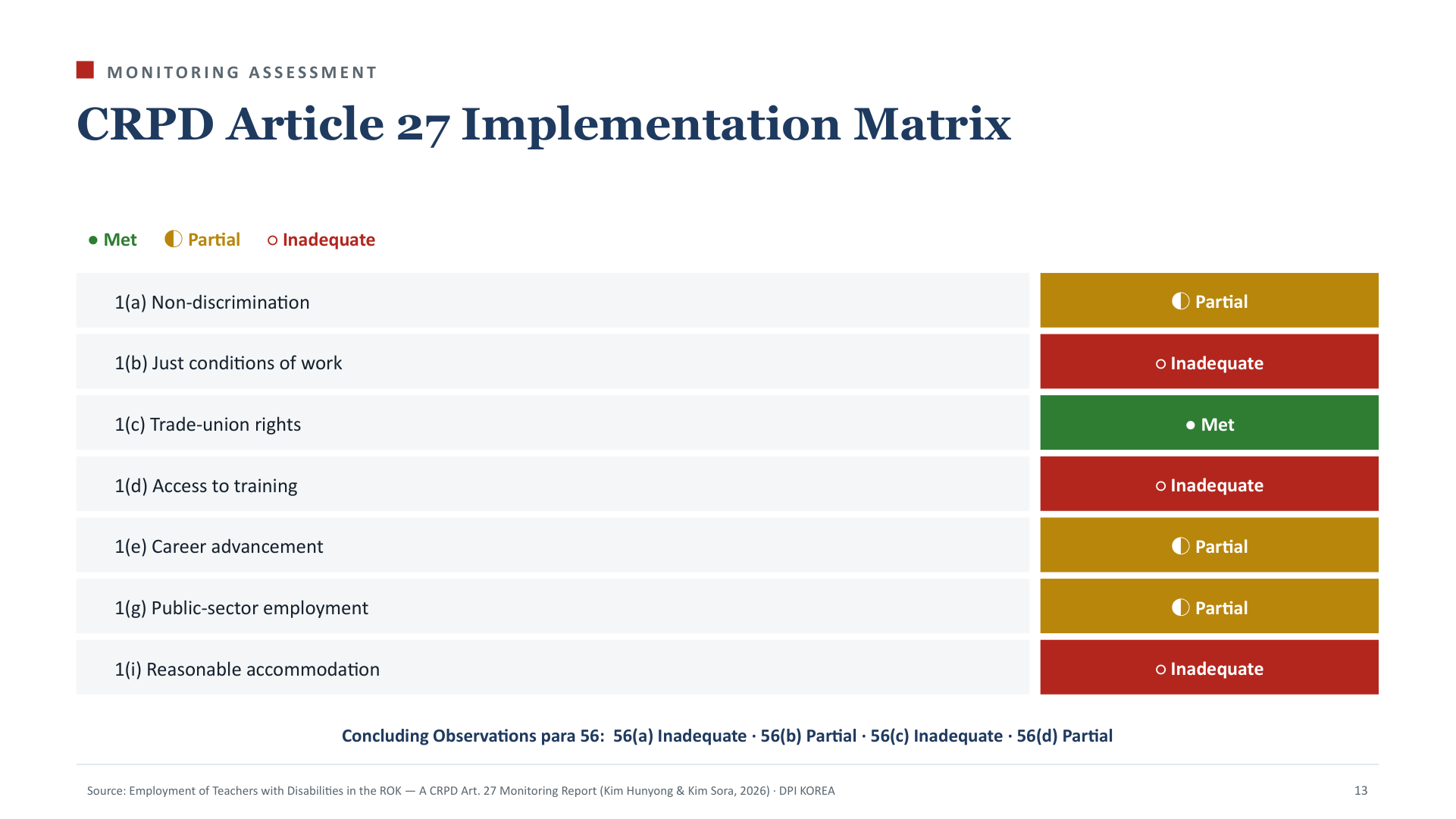
Monitoring Assessment — CRPD Article 27 Implementation Matrix
Concluding Observations para 56: 56(a) Inadequate · 56(b) Partial · 56(c) Inadequate · 56(d) Partial
- 1(a) Non-discrimination: 부분
- 1(b) Just conditions of work: 미흡
- 1(c) Trade-union rights: 이행
- 1(d) Access to training: 미흡
- 1(e) Career advancement: 부분
- 1(g) Public-sector employment: 부분
- 1(i) Reasonable accommodation: 미흡
Slide 15
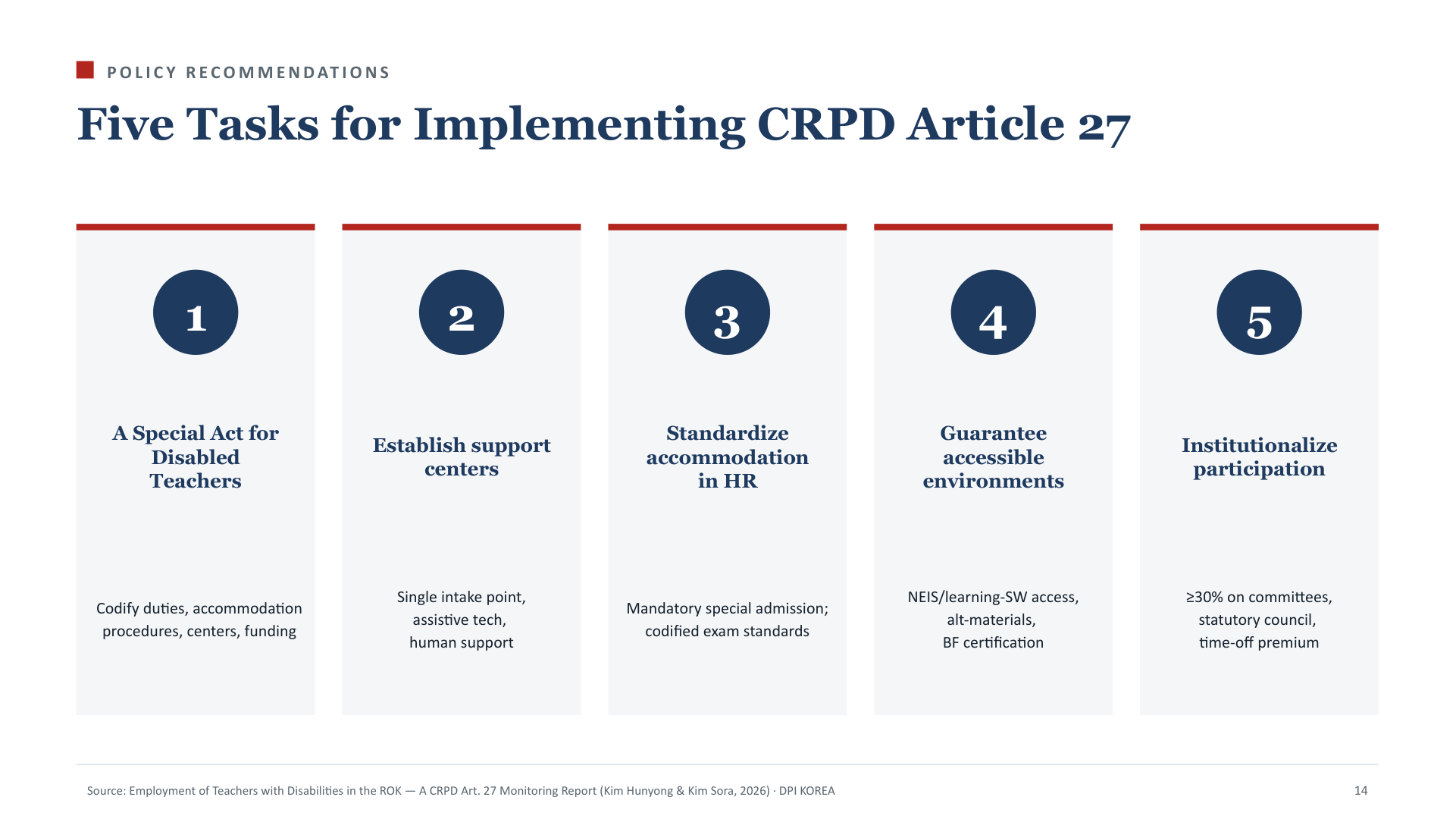
Policy Recommendations — Five Tasks for Implementing CRPD Article 27
- A Special Act for Disabled Teachers — Codify duties, accommodation procedures, centers, funding
- Establish support centers — Single intake point, assistive tech, human support
- Standardize accommodation in HR — Mandatory special admission; codified exam standards
- Guarantee accessible environments — NEIS/learning-SW access, alt-materials, BF certification
- Institutionalize participation — ≥30% on committees, statutory council, time-off premium